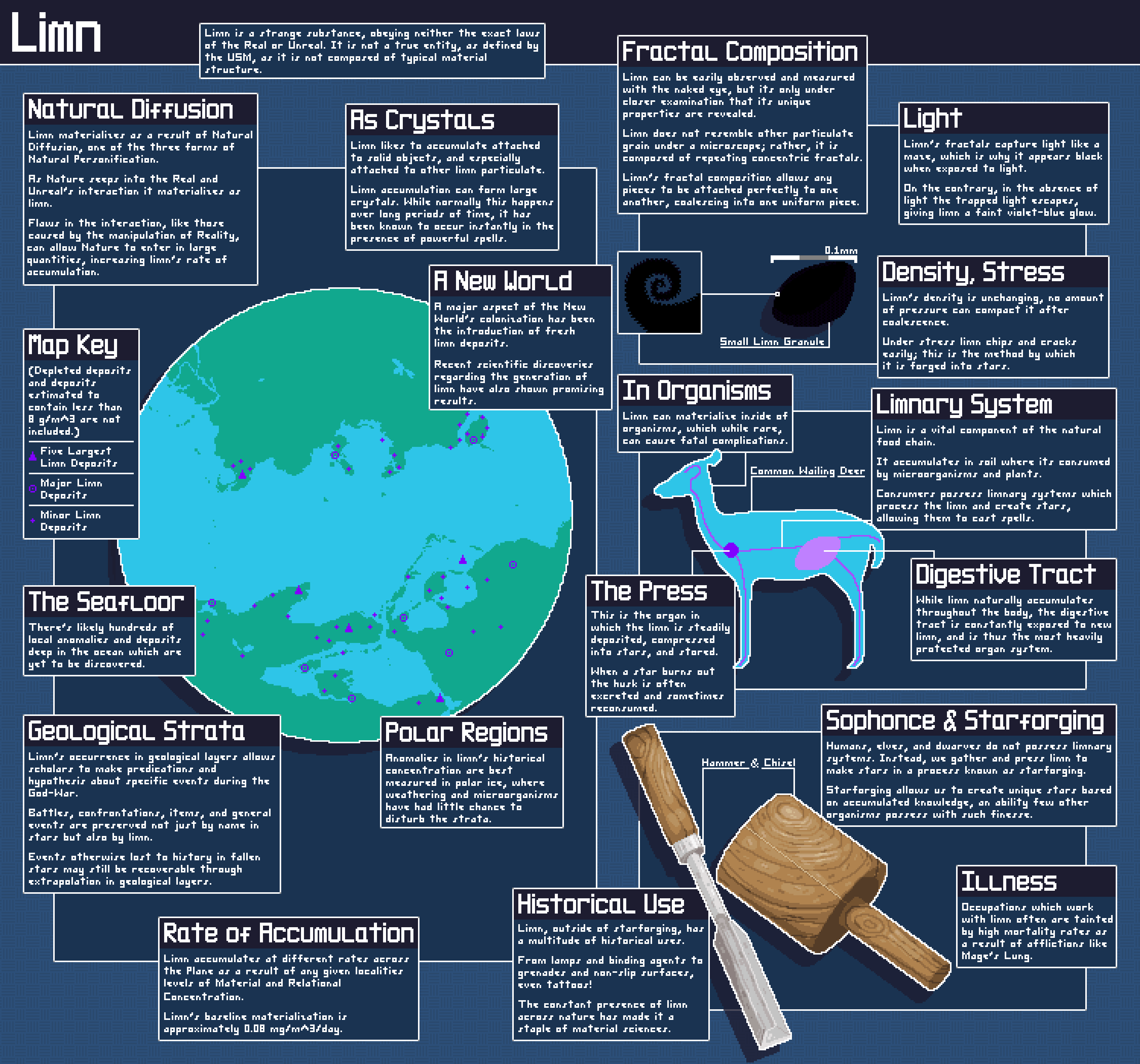
Limn, as described in the Universal Strata Model, is a product of Natural Personification, specifically Natural Diffusion: a result of Realities unstable nature, allowing Nature to seep in1. Limn is a strange substance, obeying neither the exact laws of the Real or Unreal. Because of this, limn is not a true entity as defined by the USM, as it is not constructed from a normal material structure.
Characteristics
Limn is observed and measured easily with the naked eye and basic tools. However, it is under closer examination that its unique composition is revealed. Limn does not resemble other particulate grains, such as salts or sugars. Instead, each grain appears to be constructed from a repeating concentric geometric fractal pattern—best described as claws.
These claws give limn a notable property: they press together easily to form larger masses, but once compacted, it becomes difficult to separate. When joined, limn grains do not only merely stick—they become indistinguishable. To separate them, the mass must be cracked apart with high-frequency vibrations, most commonly performed by starforgers with a hammer and chisel. Limn does not just hook to itself, however. Limn attaches to anything it makes contact with, hooking onto surfaces and increasing friction.
Beyond its cohesive structure, limn’s fractal geometry serves as a microscopic trap for light—an endless maze. This structure is responsible for limn’s iconic black coloration when exposed to light. In the absence of external light, another property of limn becomes visible. Limn emits a typically faint violet-blue glow, resulting from the escape of trapped light. This glow can be magnified through overexposure of limn to light.
Limn has an unchanging density, 0.12 g/cm³. No amount of pressure can be exerted to compact limn any further. Limn’s density is low enough that it is naturally buoyant in water.
Limn has no known chemical reactions.
Occurrence
Limn accumulates throughout Reality at a steady rate, though interferences—such as the presence of Gods and stars—can substantially accelerate its materialization. The baseline rate of materialization is approximately 0.08 mg/m³/day, though this fluctuates dependent on one’s geographical position. The average limn grain is about 1.16mm in diameter, though sizes range from 0.05mm to over 11mm.
The passive presence of a single God can increase this rate by upwards of 6,500 times. Stars are known to increase materialization rate too, though the numbers are much smaller and variable. It’s unknown how much a true star may increase materialization by. Artificial stars increase dependent on their size and complexity. The average lamp boosts it no more than a sixteenth as much. Active manipulation of Reality—by Gods or stars—can increase the rate by significantly greater magnitudes, in some instances being capable of forming immediate crystals.
Limn only materializes when adhered to other matter, such as within or directly attached to an object, and does not accumulate in the atmosphere. Limn also prefers to materialize adhered to other portions of limn, forming crystalline structures.
While rare, limn can materialize inside organisms. Normally this poses no risk to the organism, as their bodies are capable of processing the limn. However potentially fatal complications can arise if the limn develops into larger crystals which the body is unable to process. Purple Lung is a disease often found in people who regularly work with limn.
Application & History
The accumulation of limn in soil is used by microorganisms, especially species of plants and vermin, who passively absorb it. These organisms do not typically use limn for anything in particular, instead it accumulates through the food chain and is used by other organisms. Limn-utilizing organisms have an organ known as the limnary press which turns limn into artificial stars in much the same way as sophonts do.
Sophonts do not possess limnary presses—instead, they press their own artificial stars by hand in an art known as starforging. Artificial stars have their own suite of unique purposes unrelated to limn. Besides artificial stars, limn also has its own suite of purposes, including: lamps, binding agents, grenades, paint, non-slip surfaces, and tattoos.
This article is considered complete for the moment, but is missing sections which can be elaborated on as the setting develops! If you think it needs expansion now, suggest an edit through a GitHub issue!
This article could use elaboration on its history and impact on cultures.